Chile-Argentina Border Crossing by Car: Complete Guide for Self-Drivers
Everything you need to know about crossing the Chile-Argentina border by car in Patagonia. From permits and documentation to wait times, food restrictions, and step-by-step procedures - your complete 2026 guide.

Patagonia's most spectacular destinations span both Chile and Argentina. Torres del Paine lies in Chile, while Perito Moreno Glacier and El Chalten are in Argentina - often just hours apart by car. A cross-border road trip lets you experience both sides of this magnificent region in one journey.
However, crossing the Chile-Argentina border by car is not as simple as driving across European borders. The process involves specific permits, documentation requirements, food restrictions, and customs procedures that can catch unprepared travelers off guard.
This guide provides everything you need to successfully cross the Patagonian border with a rental car, avoiding delays, fines, and frustration.
What is a Border Crossing Permit?
When you rent a car in Chile or Argentina, the vehicle is registered in that country and typically not authorized to leave. To cross the border, you need a special notarized authorization letter called a Poder Notarial (Notarial Power) in Spanish.
This document gives you legal permission to take the rental company's vehicle across international borders.
Costs and Timeline
Permit costs vary by rental company:
- Budget/Economy companies: $80-$120 USD
- International chains (Hertz, Europcar, Budget): $120-$180 USD
- Premium/luxury vehicles: $150-$250 USD
Processing time:
- Minimum advance notice: 10-14 days before crossing
- High season (December-February): Request 3-4 weeks ahead
- Why so long? The rental company must have the documents notarized by a Chilean or Argentine notary public, which requires appointments and processing time.
What Companies Actually Allow Crossings?
Not all rental companies permit border crossings. Based on 2026 data:
Companies that generally allow crossings:
- Europcar (both Chile and Argentina offices)
- Hertz
- Budget
- Avis
- Localiza (Argentina)
- Rosselot (Chile - specialized in border crossings)
Companies with restrictions:
- Sixt (case-by-case basis)
- Most local independent operators
- Airport-only rental desks (often subcontractors)
Companies that typically do NOT allow crossings:
- Econorent
- Most budget local operators
- Peer-to-peer platforms
Always verify border crossing policies directly with your rental company during the booking process, not after arrival.
1. Paso Integración Austral (Cancha Carrera/Río Turbio)
Route: Puerto Natales (Chile) ↔ El Calafate (Argentina)
Why it's the most popular:
- Most direct route connecting Chilean and Argentine Patagonia
- Well-maintained road (mostly paved)
- Operates year-round
- Fastest option for Torres del Paine to El Calafate trips
Key statistics:
- Distance: 290 km total (Puerto Natales to El Calafate)
- Drive time: 4.5-5 hours including border crossing
- Border processing time: 30-90 minutes (varies by season)
- Operating hours: 8:00 AM - 11:00 PM (summer), 8:00 AM - 8:00 PM (winter)
Facilities:
- Duty-free shop (Chile side)
- Restrooms (both sides)
- Money exchange (limited hours)
- Small café (Chilean side)
2. Paso Dorotea
Route: Puerto Natales (Chile) ↔ Ruta 40 (Argentina)
Why travelers choose it:
- Alternative to Cancha Carrera during peak season
- Less traffic in summer months
- Access to scenic Ruta 40
- Handles approximately 39% of regional border entries
Key statistics:
- Distance: 315 km to El Calafate
- Drive time: 5-5.5 hours including border
- Border processing time: 20-60 minutes
- Operating hours: 8:00 AM - 10:00 PM (summer), 8:00 AM - 6:00 PM (winter)
Facilities:
- Basic restrooms
- No shops or cafés
- Limited mobile coverage
3. Paso Casas Viejas
Route: Connects Villa O'Higgins (Chile) ↔ Argentina
For adventurous travelers:
- Remote crossing requiring high clearance or 4WD
- Part of the legendary Carretera Austral route
- Operates summer only (December-March)
- Very limited traffic
4. Paso San Sebastián (Tierra del Fuego)
Route: Chilean Tierra del Fuego ↔ Argentine Tierra del Fuego
For Ushuaia-bound travelers:
- Necessary for reaching Ushuaia from Punta Arenas
- Mostly flat terrain
- Strong winds common
- Operates year-round
Before you approach the border, ensure you have all required documents organized and easily accessible:
Essential Documents (Required)
- Passport - Original, not expired, with valid entry stamps
- Rental car contract - Original or certified copy
- Poder Notarial - Notarized authorization letter from rental company
- Vehicle registration (Padrón) - Provided by rental company
- Proof of insurance - Valid in both Chile and Argentina
- Driver's license - Your home country license
Recommended Documents
- International Driving Permit (IDP) - Not always required but strongly recommended
- Rental company contact information - Phone numbers for emergencies
- Reservation confirmations - Hotel bookings in destination country
- Return flight itinerary - Sometimes requested to prove you'll return
Argentina-Specific Requirements
When entering Argentina, you may also need:
- CDI (Código de Identificación) - Temporary vehicle import permit (provided at border)
- Declaration form - Customs declaration (provided at border)
Chile-Specific Requirements
When entering Chile:
- Agricultural inspection slip - Proof of vehicle inspection (received at border)
- Customs form - Declaration of goods (provided at border)
Crossing from Chile to Argentina
Step 1: Chile Exit (Aduana Chile)
- Join the appropriate lane (cars vs. trucks/buses)
- Stop at the first checkpoint
- Present passports to Chilean immigration officer
- Officer will stamp your passport with exit stamp
- Proceed to Chilean customs inspection
Step 2: Chilean Customs & Agricultural Inspection
- Declare all food items you're carrying
- Agricultural inspectors will search your vehicle for prohibited items
- You MUST dispose of all fresh produce, meat, dairy before this point
- X-ray screening of luggage (sometimes)
- Receive clearance to proceed
Step 3: No Man's Land
- Drive approximately 5-15 km between borders
- Road conditions vary (mostly paved, some gravel)
- No stopping allowed in this zone
- Watch for wildlife (guanacos, foxes)
Step 4: Argentina Entry (Aduana Argentina)
- Stop at Argentine immigration checkpoint
- Present passports
- Officer asks purpose of visit, duration of stay
- Receive entry stamp in passport
- Proceed to vehicle inspection
Step 5: Argentine Customs & Vehicle Documentation
- Present all vehicle documents (rental contract, Poder Notarial, insurance)
- Officer may inspect vehicle for undeclared goods
- Receive temporary vehicle import permit (CDI)
- IMPORTANT: Keep this CDI with you at all times - you'll need it to exit Argentina
- Clearance to enter Argentina
Total time: 30-90 minutes for the complete process (longer during peak season)
Crossing from Argentina to Chile
The process is similar but with key differences:
Argentina Exit:
- Return your vehicle CDI permit
- Exit stamp in passport
- Less strict food inspection (but still declare everything)
Chile Entry:
- More rigorous agricultural inspection
- Chile has VERY strict biosecurity rules
- Luggage X-ray screening is common
- Fresh food confiscation is guaranteed
What You CANNOT Bring Across the Border
Both Chile and Argentina enforce strict agricultural biosecurity laws. The following items are ALWAYS prohibited:
Fresh Products:
- Fresh fruits (apples, oranges, bananas, etc.)
- Fresh vegetables (tomatoes, lettuce, carrots, etc.)
- Fresh herbs (cilantro, parsley, etc.)
- Mushrooms
Animal Products:
- Fresh meat (beef, chicken, pork, etc.)
- Fresh dairy (cheese, milk, yogurt, butter)
- Eggs
- Honey
- Salami and cured meats (even vacuum-sealed)
Plant Materials:
- Seeds
- Plants or flowers
- Soil
- Firewood
What You CAN Bring
Generally allowed items:
- Commercially packaged snacks (chips, cookies, crackers)
- Canned goods (sealed, commercially produced)
- Dried pasta (in original packaging)
- Coffee and tea (packaged)
- Chocolate and candy (packaged)
- Bottled water and soft drinks
- Alcohol (within duty-free limits: 2 liters per person)
Pro tip: When in doubt, declare it. Officers appreciate honesty and may allow items if properly declared. Undeclared items result in automatic fines.
Penalties for Prohibited Items
Chile penalties (SAG - Agricultural Service):
- First offense: $200-$500 USD fine
- Repeat offenses: $500-$2,000 USD
- Serious violations: Vehicle confiscation, criminal charges
Argentina penalties (SENASA):
- First offense: $150-$400 USD fine
- Undeclared contraband: $400-$1,500 USD
- Commercial quantities: Seizure and prosecution
Smart Strategy: Shop After Crossing
The best approach is to empty your cooler before the border and restock on the other side:
- Eat fresh food for breakfast on crossing day
- Dispose of remaining perishables before Chilean exit
- Cross with minimal food
- Stop at the first supermarket after crossing to restock
Major towns near borders:
- Chile side: Puerto Natales, Punta Arenas
- Argentina side: El Calafate, Río Turbio, El Chaltén
Minimum Coverage Required
Both Chile and Argentina require proof of valid vehicle insurance covering:
- Third-party liability - Bodily injury and property damage to others
- Minimum coverage amounts:
- Chile: UF 2,000 (~$80,000 USD)
- Argentina: $100,000 USD equivalent
Types of Insurance
Basic Coverage (Included with most rentals):
- Third-party liability (mandatory)
- Usually covers only minimum legal requirements
Enhanced Coverage (Recommended for border crossings):
- Collision Damage Waiver (CDW) - Covers damage to rental vehicle
- Theft protection
- Super CDW (reduces deductible to zero)
- Personal accident insurance
Cross-Border Coverage:
Not all insurance policies automatically extend across borders. Your rental company must provide a policy that explicitly states:
- "Valid in Chile and Argentina"
- Policy numbers for both countries
- Emergency contact numbers for both sides
Cost: Cross-border insurance adds $10-$25 USD per day to rental cost.
What to Verify Before Crossing
Before leaving the rental office, confirm:
- Insurance certificate lists both countries
- Policy is valid for your entire trip duration
- You have emergency roadside assistance numbers for both countries
- Deductible amount is clearly stated
- Coverage includes gravel road damage (common in Patagonia)
Emergency Insurance Issues
If you have an accident or damage:
- Call the rental company immediately - They will guide you through the process
- File a police report - Required in both countries for insurance claims
- Document everything - Photos of damage, other vehicles, location
- Do NOT admit fault - Let insurance companies determine liability
- Notify your travel insurance - If you have separate travel coverage
Peak Season (December - February)
Busiest periods:
- Christmas week (December 20-28)
- New Year's week (December 28 - January 5)
- January school holidays (entire month)
Average wait times:
- Weekdays: 45-90 minutes total
- Weekends: 90-150 minutes total
- Holiday periods: 2-4 hours possible
Busiest hours:
- 10:00 AM - 1:00 PM (tour buses and day-trippers)
- 4:00 PM - 6:00 PM (afternoon crossing rush)
Shoulder Season (October-November, March-April)
Average wait times:
- Weekdays: 20-45 minutes
- Weekends: 30-60 minutes
Low Season (May - September)
Average wait times:
- Weekdays: 15-30 minutes
- Weekends: 20-40 minutes
Note: Some crossings have reduced hours or close temporarily during winter storms. Check current status before traveling.
Best Times to Cross
Optimal crossing windows:
- Early morning (8:00-9:30 AM) - Border just opened, fewer travelers
- Early afternoon (1:30-3:00 PM) - Between lunch and afternoon rush
- Weekdays - Always less busy than weekends
- Avoid Fridays/Sundays - Heaviest weekend traffic
Real-time border wait information:
- Chile border status: Paso a Paso Chile
- Argentina border status: Migraciones Argentina
1. Not Requesting Border Permit Early Enough
Mistake: Booking a rental car 3 days before your trip and expecting border crossing authorization.
Reality: Rental companies need 10-14 days minimum to prepare notarized documents.
Solution: Request border crossing authorization when you first book the rental, even if your trip is months away.
2. Assuming All Rental Companies Allow Crossings
Mistake: Booking the cheapest rental without checking border crossing policy.
Reality: Budget companies often prohibit border crossings entirely.
Solution: Explicitly ask "Does your company allow border crossings to Argentina/Chile?" before booking. Get written confirmation.
3. Bringing Prohibited Food Items
Mistake: Packing a cooler full of groceries to save money across the border.
Reality: All fresh food will be confiscated, and you'll face fines of $200+ USD.
Solution: Consume or dispose of all fresh food before reaching the border. Buy new supplies after crossing.
4. Not Having Correct Documentation
Mistake: Leaving the Poder Notarial at the hotel or not checking if insurance covers both countries.
Reality: Border officials WILL turn you back without proper paperwork.
Solution: Create a "border folder" with all documents and keep it in the car's glove compartment.
5. Crossing at Peak Times
Mistake: Planning to cross at noon on a Saturday in January.
Reality: You'll wait 2-3 hours in line.
Solution: Cross early morning on a weekday when possible.
6. Not Declaring Items
Mistake: Hiding a salami sandwich because "it's just one item."
Reality: Detection dogs WILL find it, and undeclared items carry automatic fines.
Solution: Declare absolutely everything. Officers may let declared items pass but will fine undeclared ones.
7. Forgetting to Keep CDI Document
Mistake: Receiving the Argentine vehicle import slip (CDI) and losing it during your trip.
Reality: You cannot exit Argentina without returning this document. Lost CDI requires filing police reports and waiting for replacement.
Solution: Tape the CDI to your vehicle registration and keep both in the glove box at all times.
Puerto Natales (Chile) → El Calafate (Argentina)
Best crossing: Paso Integración Austral (Cancha Carrera/Río Turbio)
Route:
- Depart Puerto Natales north on Route 9
- After 60 km, turn right onto Y-290 toward Cerro Castillo
- Continue 160 km to Chile border checkpoint
- Cross to Argentina (Río Turbio)
- Continue 70 km to El Calafate
Total distance: 290 km Driving time: 4.5-5 hours including border Road conditions: Paved until border, gravel section in Argentina, paved again near El Calafate
Torres del Paine (Chile) → El Chaltén (Argentina)
Best crossing: Paso Integración Austral → El Calafate → Route 23 → El Chaltén
Route:
- Exit Torres del Paine via Laguna Amarga entrance
- Drive to Puerto Natales (follow above route to El Calafate)
- From El Calafate, take Route 11 north
- Merge onto Route 40 north
- Turn onto Route 23 west to El Chaltén
Total distance: 510 km Driving time: 8-9 hours including border Road conditions: Mixed paved and gravel, very scenic
Punta Arenas (Chile) → Ushuaia (Argentina)
Best crossing: Paso San Sebastián (Tierra del Fuego)
Route:
- From Punta Arenas, head north on Route 9
- Ferry crossing at Punta Delgada (30-40 min wait + 20 min crossing)
- Continue on Route 257 east
- Cross border at Paso San Sebastián
- Follow Route 3 south through Río Grande to Ushuaia
Total distance: 610 km Driving time: 12-14 hours including ferry and border Road conditions: Paved, but very windy and remote
Summer (December - February)
Advantages:
- All border crossings open with extended hours
- Best weather for driving
- Paved roads in excellent condition
Disadvantages:
- Longest wait times at borders
- Higher rental car costs
- Mandatory advance bookings
Tips:
- Cross on weekdays before 9 AM
- Book permits 3-4 weeks ahead
- Carry extra water and snacks for potential delays
Shoulder Season (October-November, March-April)
Advantages:
- Moderate wait times (30-60 minutes)
- Pleasant weather, less wind
- Lower rental costs
- More flexibility with bookings
Disadvantages:
- Some crossings may have reduced hours
- Unpredictable weather (snow possible)
- Shorter daylight hours
Tips:
- Check border hours before traveling
- Carry warm clothing layers
- Best value for self-drive trips
Winter (May - September)
Advantages:
- Minimal wait times at borders
- Lowest rental car prices
- Unique winter scenery
Disadvantages:
- Some crossings close or operate limited hours
- Snow and ice on roads
- Very short daylight (8-9 hours)
- Strong winds
Tips:
- Only attempt with 4WD and winter driving experience
- Verify border crossing hours (many reduce to 8 AM - 6 PM)
- Carry emergency supplies (blankets, food, water)
- Some remote crossings close entirely
Denied Border Crossing
Reasons you might be denied:
- Missing or incorrect documentation
- Prohibited items in vehicle
- Visa issues (some nationalities need visas)
- Vehicle registration problems
What to do:
- Ask the border officer specifically what's wrong
- Call your rental company for assistance
- If it's a documentation issue, ask if you can obtain it nearby
- Be polite and patient - arguing never helps
Lost or Damaged Documents
Lost Poder Notarial:
- Contact rental company immediately
- They may be able to email a scanned copy to nearest town
- You may need to return to rental city to get a replacement
Lost vehicle CDI (Argentina):
- Report to local police (Comisaría)
- Obtain police report
- Contact Argentine customs (Aduana)
- Process can take 1-3 days
Vehicle Breakdown Near Border
Before crossing:
- Contact rental company roadside assistance
- They'll send a replacement vehicle or tow truck
- You may need to postpone crossing
After crossing:
- Use the emergency number on your cross-border insurance
- Assistance available on both sides
- Rental company coordinates repair or replacement
Accidents at or Near Border
- Ensure safety first - Move to safe location if possible
- Call police - Required for insurance claims in both countries
- Contact rental company - They'll guide next steps
- Document everything - Photos, witness info, police report number
- Do NOT leave the country - Complete all procedures before exiting
Here's what you can expect to pay for a typical Puerto Natales → El Calafate → Torres del Paine trip:
Rental Car (7 days, SUV):
- Base rate: $420 USD ($60/day × 7 days)
- Border crossing permit: $150 USD
- Full insurance (SCDW): $140 USD ($20/day × 7 days)
- Additional driver: $35 USD ($5/day × 7 days)
- Subtotal: $745 USD
Fuel Costs:
- Total distance: ~800 km round trip
- Fuel consumption: 10L/100km (average SUV)
- Total fuel needed: 80 liters
- Chile fuel price: ~$1.30 USD/liter
- Argentina fuel price: ~$1.10 USD/liter
- Estimated fuel cost: $95 USD
Other Costs:
- Border crossing (no toll, but budget for delays): $0
- Food purchased after crossing: $40 USD
- Subtotal: $40 USD
Total estimated cost: $880 USD for 7-day self-drive trip across borders
Compare to: Organized tours covering same route typically cost $1,200-$1,800 per person, making self-drive excellent value for couples or groups.
- Aduana Argentina - Official Argentine customs authority with border crossing regulations
- Servicio Agrícola y Ganadero (SAG) Chile - Chilean agricultural service with biosecurity rules and prohibited items lists
- Dirección Nacional de Migraciones Argentina - Argentine immigration service with border status updates
- Policía de Investigaciones de Chile (PDI) - Chilean border police with crossing hours and requirements
- Paso a Paso Chile - Real-time border crossing status for all Chilean crossings
- Vialidad Nacional Argentina - Argentine road authority with Ruta 40 and border access road conditions
- CONAF Chile - Chilean forestry service with Torres del Paine road information
- Ministerio de Relaciones Exteriores Chile - Chilean foreign ministry with visa requirements by nationality
Successfully crossing the Chile-Argentina border by rental car requires planning, proper documentation, and understanding the procedures. With the information in this guide, you're prepared to navigate the process smoothly.
Key takeaways:
- Request border crossing permits 10-14 days in advance
- Verify your rental company allows border crossings before booking
- Dispose of all fresh food before reaching the border
- Carry all required documents in an organized folder
- Cross early in the morning on weekdays when possible
- Budget $80-$200 for border crossing permit fees
Browse our related guides for specific border crossings and detailed routes, or explore our rental car listings to find vehicles approved for border crossings.
Next steps:
- Choose your border crossing route based on your itinerary
- Book a rental car with border crossing authorization
- Review our spoke guides for specific crossing procedures
- Plan your fuel stops using our fuel station guide
- Pack smart - leave the fresh food at home
Safe travels, and enjoy the incredible journey across Patagonia!
Frequently Asked Questions
How much does a border crossing permit cost for a rental car?
Border crossing permits for rental cars cost between $80-$200 USD depending on the rental company and duration. You must request this permit 10-14 days before your crossing date, as the rental company needs time to prepare the notarized authorization documents.
Which border crossing is best for driving from Puerto Natales to El Calafate?
The Paso Integración Austral (Cancha Carrera/Río Turbio crossing) is the most direct route from Puerto Natales to El Calafate, taking approximately 5 hours total. The Dorotea crossing is an alternative that handles 39% of regional entries but adds about 30 minutes to your journey.
Can I bring food across the Chile-Argentina border?
No. Fresh fruits, vegetables, meat, dairy products, honey, and seeds are strictly prohibited from crossing the border in either direction. Packaged, commercially sealed snacks are usually allowed. Declare everything you have - penalties for undeclared items start at $200 USD and can include vehicle confiscation.
What documents do I need to cross the border with a rental car?
You need: (1) Notarized authorization letter (Poder Notarial) from the rental company, (2) Vehicle registration document (Padrón), (3) Proof of insurance valid in both countries, (4) Your passport, (5) Rental contract, and (6) International Driving Permit (recommended but not always required).
What are the border crossing hours?
Most Patagonian border crossings operate 8:00 AM - 11:00 PM daily during summer (December-February) and 8:00 AM - 8:00 PM during winter (May-August). Paso Integración Austral operates year-round. Always verify current hours before your trip as they can change seasonally.
Do all rental car companies allow border crossings?
No. Only about 60% of rental companies in Patagonia allow border crossings, and even fewer allow one-way rentals across borders. Companies like Europcar, Hertz, and Budget generally permit crossings with advance notice, while smaller local operators often do not. Always confirm during booking.
Image Generation Prompt
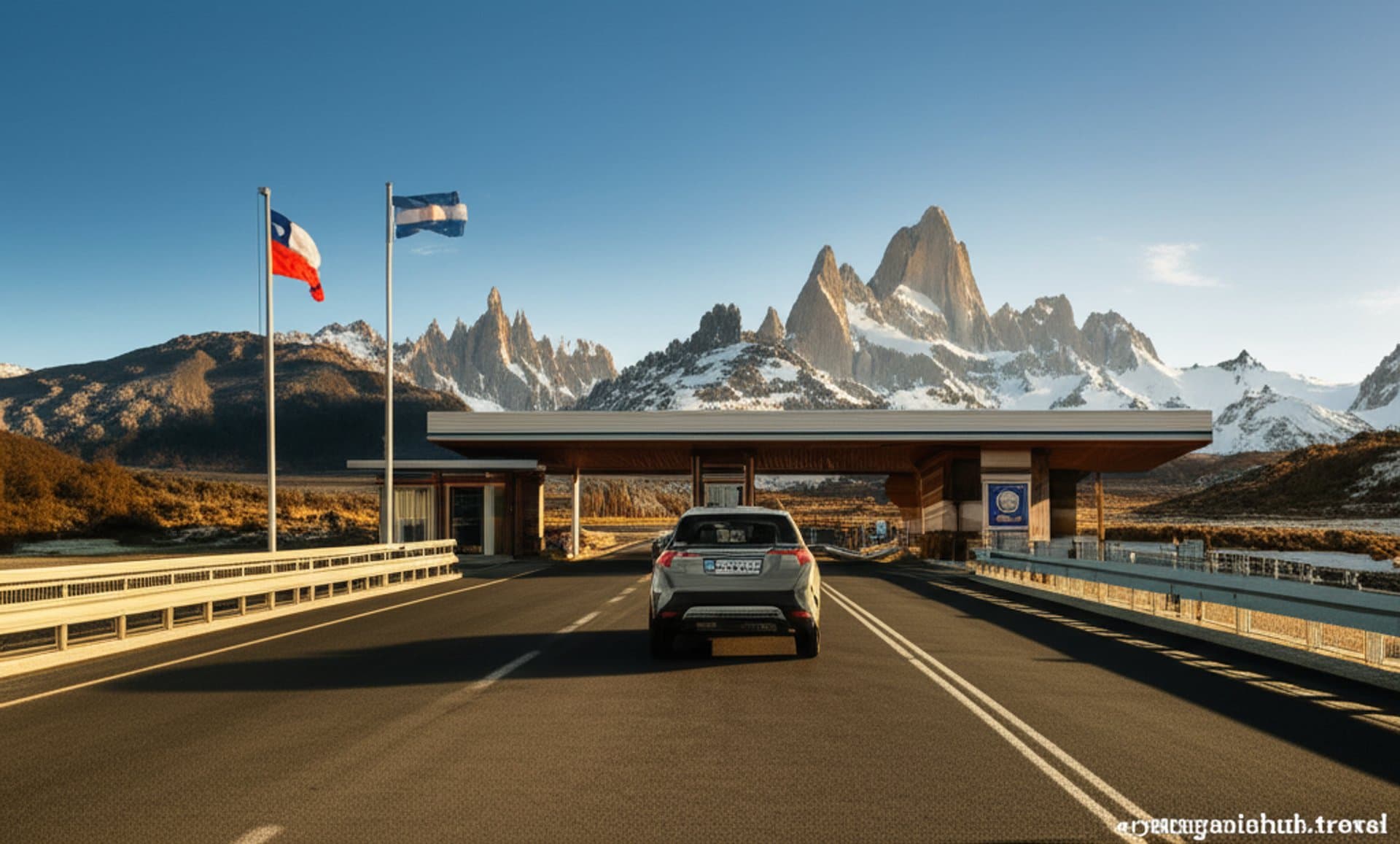
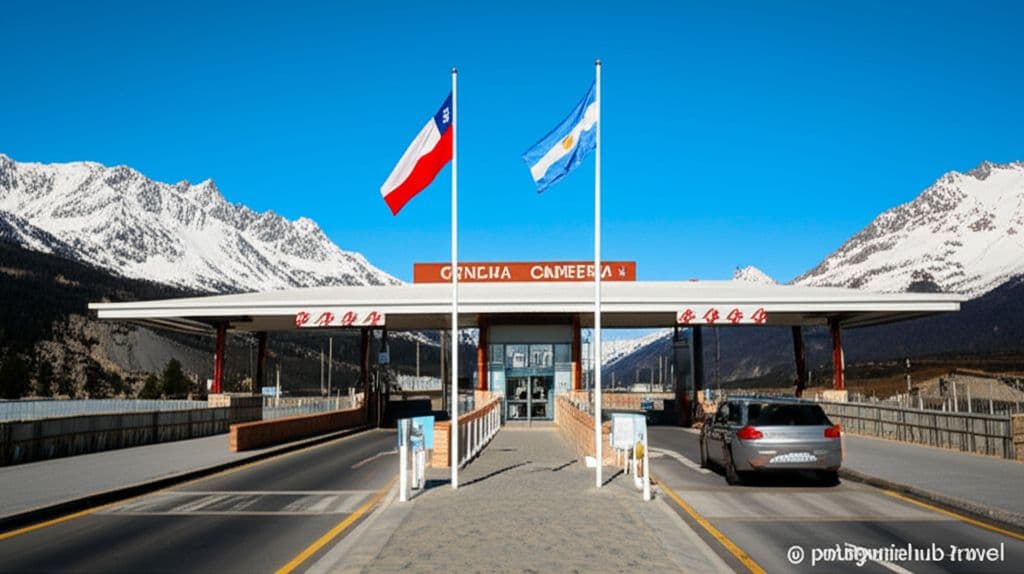
Create a professional, wide-angle photograph of a border crossing checkpoint in Patagonia featuring a modern car approaching the border post with dramatic Patagonian mountains in the background. The scene should show the official border building with Chilean and Argentine flags visible. Style: Cinematic travel photography with clear blue sky, golden hour lighting, 16:9 aspect ratio. No people in focus, professional quality. Include subtle 'patagoniahub.travel' branding in the bottom right corner.
Related Guides in This Series
Argentina to Chile by Car: Insurance Requirements Explained (2026)
Clear guide to car insurance requirements for crossing the Argentina-Chile border. Learn about mandatory coverage, cross-border policies, rental company insurance, and what documents you need at the border.
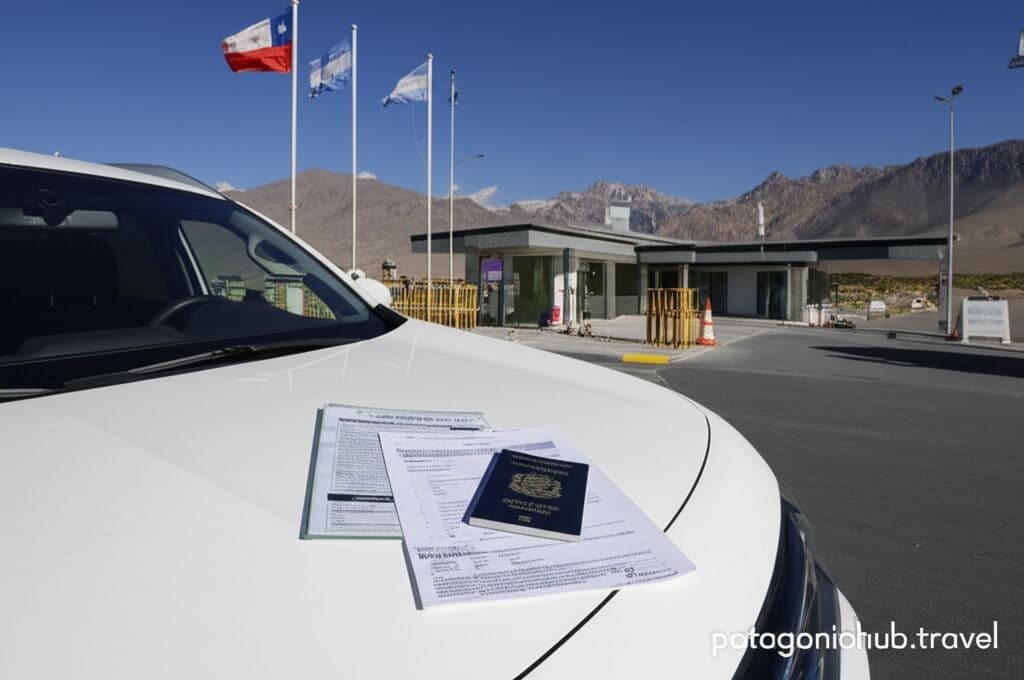
Border Crossing Permits for Rental Cars: Complete Documentation Guide
Complete guide to border crossing permits for rental cars in Patagonia. Learn about Poder Notarial requirements, costs ($80-$200), processing times (10-14 days), insurance, and essential documents needed to cross Chile-Argentina borders.
Best Time to Cross the Chile-Argentina Border: Wait Time Guide
Strategic timing guide for Chile-Argentina border crossings in Patagonia. Learn the best times of day, days of week, and seasons to minimize wait times, plus what affects delays and how to plan your crossing.
Related Guides
Border Crossing Permits for Rental Cars: Complete Documentation Guide
Complete guide to border crossing permits for rental cars in Patagonia. Learn about Poder Notarial requirements, costs ($80-$200), processing times (10-14 days), insurance, and essential documents needed to cross Chile-Argentina borders.
Best Time to Cross the Chile-Argentina Border: Wait Time Guide
Strategic timing guide for Chile-Argentina border crossings in Patagonia. Learn the best times of day, days of week, and seasons to minimize wait times, plus what affects delays and how to plan your crossing.
Cancha Carrera Border Crossing: Complete Step-by-Step Guide 2026
Detailed walkthrough of the Cancha Carrera / Río Turbio border crossing between Puerto Natales and El Calafate. Step-by-step procedures, documents, timings, and tips to cross smoothly.