Border Crossing Permits for Rental Cars: Complete Documentation Guide
Complete guide to border crossing permits for rental cars in Patagonia. Learn about Poder Notarial requirements, costs ($80-$200), processing times (10-14 days), insurance, and essential documents needed to cross Chile-Argentina borders.

Crossing the Chile-Argentina border with a rental car requires more than just your driver's license and passport. The vehicle you're renting is registered in one country and legally cannot leave without proper authorization from the owner - the rental company.
This authorization comes in the form of a Poder Notarial (Notarial Power), a legally binding document notarized by a Chilean or Argentine public notary. Without this document, border officials will turn you away, potentially disrupting your entire Patagonia itinerary.
The reality: About 40% of travelers attempting border crossings with rental cars are turned back due to missing or incorrect documentation. This guide ensures you're not one of them.
What Exactly Is a Poder Notarial?
A Poder Notarial is a legal authorization letter that grants you temporary power of attorney to take the rental company's vehicle across international borders. This document must be:
- Notarized by a Chilean or Argentine public notary (Notario Público)
- Written in Spanish with legal terminology specific to vehicle authorization
- Signed by authorized representatives of the rental company
- Original document (photocopies are not accepted at borders)
The document explicitly states:
- Vehicle identification (make, model, year, license plate, VIN)
- Renter's full name and passport number
- Authorized countries (Chile and Argentina)
- Validity dates for the authorization
- Rental company's legal details and signatures
Legal Framework
Both Chile and Argentina require this document under their vehicle import regulations:
Chile: Law 18.483 (Vehicle Taxation) requires written authorization for non-owner vehicle export Argentina: Customs Code Article 440 requires proof of ownership or authorization for temporary vehicle imports
How It Differs From Regular Rental Contracts
| Document | Purpose | Legal Status | Border Recognition |
|---|---|---|---|
| Rental Contract | Proves you rented the vehicle | Private agreement | Not sufficient for borders |
| Poder Notarial | Authorizes international travel | Notarized legal document | Required by law |
| Vehicle Registration | Proves ownership | Government registration | Required + must match authorization |
Critical distinction: Your rental contract only proves you have permission to drive the car in the rental country. The Poder Notarial proves the owner (rental company) consents to the vehicle leaving the country temporarily.
Before approaching any Chile-Argentina border, ensure you have ALL of these documents organized and easily accessible:
Essential Documents (Mandatory)
-
Poder Notarial - Original notarized authorization letter
- Must be signed and sealed by notary
- Must list your exact name as it appears on passport
- Must include vehicle VIN, license plate, make, and model
- Must specify Chile and Argentina as authorized countries
-
Padrón del Vehículo (Vehicle Registration)
- Original or certified copy
- Provided by rental company
- Must match vehicle you're driving
- Shows the rental company as legal owner
-
Rental Contract (Contrato de Arriendo)
- Original or certified copy
- Must include your full name
- Must show rental period covers your crossing dates
- Should explicitly mention border crossing authorization
-
Proof of Insurance (Seguro)
- Insurance certificate valid in BOTH Chile and Argentina
- Must show minimum required coverage amounts
- Should include emergency contact numbers for both countries
- Must cover your entire trip duration
-
Passport (Pasaporte)
- Original, not photocopy
- Must be valid for at least 6 months beyond entry date
- Ensure you have blank pages for entry/exit stamps
-
Driver's License (Licencia de Conducir)
- Your home country driver's license
- International Driving Permit (IDP) strongly recommended
Recommended Documents
-
International Driving Permit (IDP)
- Not always required, but strongly recommended
- Must be issued in your home country before traveling
- Valid for 1 year from issue date
-
Credit Card Used for Rental
- Card used to secure the rental deposit
- Border officials sometimes verify payment method
-
Rental Company Emergency Contact
- Phone numbers for Chilean and Argentine offices
- Roadside assistance numbers
- After-hours emergency numbers
-
Return Booking Confirmations
- Hotel reservations in destination country
- Return flight itinerary (if applicable)
- Sometimes requested to prove you'll return the vehicle
Documents You'll Receive at the Border
When crossing INTO Argentina, you'll receive:
- CDI (Código de Identificación del Vehículo) - Temporary vehicle import permit
- Issued by Argentine customs at the border
- CRITICAL: You MUST keep this document until exiting Argentina
- Required to be returned when leaving Argentina
- Lost CDI requires police report and can delay your exit by 1-3 days
When crossing INTO Chile, you'll receive:
- Agricultural Inspection Certificate - Proof that vehicle passed SAG inspection
- Keep until you exit Chile
- May be requested by SAG at internal checkpoints
Organizing Your Documents
Pro tip: Create a "Border Crossing Folder" with three sections:
-
Always Accessible (keep in glove compartment):
- Poder Notarial
- Padrón del Vehículo
- Rental Contract
- Insurance Certificate
- CDI (after receiving it)
-
Personal Documents (keep with you):
- Passport
- Driver's License
- IDP
- Credit Card
-
Support Documents (keep in folder but less critical):
- Emergency contact numbers
- Hotel confirmations
- Return flight details
Processing Time
Minimum advance notice required: 10-14 business days
The notarization process involves several steps that cannot be rushed:
-
Rental company prepares documents (1-2 days)
- Legal team drafts the Poder Notarial
- Verifies renter information matches passport
- Confirms vehicle details and rental dates
-
Notary appointment and notarization (3-5 days)
- Rental company schedules appointment with Notario Público
- Authorized company representative attends in person
- Notary verifies documents and witnesses signatures
- Notary seal and registration
-
Document delivery to rental office (1-2 days)
- Original document transported from notary to rental office
- Filed with your rental reservation
-
Buffer for complications (3-5 days)
- Notary appointment availability
- Document errors requiring corrections
- Holiday closures
High season (December-February): Add 1-2 weeks to standard processing time
- Notary offices are busier
- Rental companies process more requests
- Recommendation: Request 3-4 weeks in advance during peak season
Cost Structure
Border crossing permit fees vary significantly by rental company and vehicle type:
| Company Category | Typical Fee | Notes |
|---|---|---|
| Budget/Economy Local Operators | $80-$120 USD | If they allow crossings at all (many don't) |
| International Chains (Hertz, Europcar, Budget) | $120-$180 USD | Most reliable for border crossing authorization |
| Premium/Luxury Vehicles | $150-$250 USD | Higher insurance and administrative costs |
| Specialized Border Crossing Companies | $100-$150 USD | Companies like Rosselot that specialize in cross-border rentals |
What the fee covers:
- Notary fees (typically $30-$50 USD in Chile/Argentina)
- Administrative processing and legal review
- Document preparation and courier
- Additional insurance verification
- Risk premium for international travel
Payment timing:
- Usually paid at vehicle pickup (not during booking)
- Some companies require advance payment when requesting authorization
- Fee is NON-REFUNDABLE even if you don't cross the border
- Not included in quoted rental rates (always an additional charge)
Hidden Costs to Consider
Beyond the permit fee itself:
- Cross-border insurance - Additional $10-$25 per day
- One-way rental fees - $200-$500+ if dropping off in another country
- Additional driver fee - $5-$10 per day (both drivers need authorization)
- Administrative fees - Some companies charge $20-$40 processing fee
- Rush processing - If available, expect 50-100% surcharge
Example total cost for 7-day Puerto Natales → El Calafate trip:
Base rental (SUV, 7 days):                $420 USD
Border crossing permit:                   $150 USD
Cross-border insurance (7 days @ $20):    $140 USD
Additional driver:                         $35 USD
------------------------------------------------
---
Total rental cost:                        $745 USD
How to Request a Border Crossing Permit
Step 1: At Booking Time (Recommended)
When initially reserving your rental car:
- Ask explicitly: "Does your company allow border crossings to Argentina/Chile?"
- Request the permit immediately: "I need a Poder Notarial for crossing on [date]"
- Get written confirmation: Email confirmation listing permit in your reservation
- Verify lead time: "How many days in advance do you need?"
Why book early? Rental companies can deny permits if requested too close to pickup date.
Step 2: Provide Required Information
The rental company will need:
- Full name (exactly as it appears on passport)
- Passport number and expiration date
- Intended crossing date(s)
- Which border crossing you'll use
- Destination country and duration
- Co-driver information (if applicable)
Step 3: Confirm Processing Status
1 week before pickup:
- Email rental company to confirm permit is ready
- Ask if there are any issues or missing information
- Verify you'll receive original document at pickup
Step 4: Verify at Pickup
When collecting the vehicle:
- Confirm Poder Notarial is in your name
- Check that passport number matches
- Verify vehicle details (VIN, license plate) match the car
- Confirm date range covers your entire trip
- Ensure it's an ORIGINAL with notary seal (not a photocopy)
Red flag: If the rental agent says "the permit will be ready tomorrow" or "we'll email it to you," this is NOT acceptable. You need the original document before leaving the rental office.
What It Is
The Padrón del Vehículo (also called "Permiso de Circulación" in Chile or "Cédula Verde" in Argentina) is the official government vehicle registration document proving legal ownership.
Key information on this document:
- Legal owner (the rental company)
- Vehicle identification number (VIN/Chassis)
- License plate number
- Make, model, year
- Registration date and validity
- Tax payment verification
Why You Need It
Border officials verify that:
- The vehicle you're driving matches the Poder Notarial
- The rental company legally owns the vehicle
- The vehicle registration is current and valid
- Taxes have been paid in the country of origin
Without this document: Border officials cannot confirm the rental company has legal authority to authorize your crossing.
Original vs. Certified Copy
Chile: Original or certified copy acceptable Argentina: Original strongly preferred, certified copy may be accepted
What is a "certified copy"?
- Photocopy stamped and signed by a Notario Público
- States "Copia Fiel" (True Copy) or "Copia Certificada" (Certified Copy)
- Notary seal and signature
- Date of certification
Recommendation: Request the original if possible to avoid any border issues.
What to Verify at Pickup
Check that the Padrón del Vehículo:
- Shows the rental company as registered owner
- Lists the correct VIN/chassis number
- Matches the license plate on the vehicle
- Is current (not expired)
- Has a clear notary certification (if it's a copy)
Mismatch scenario: If the Padrón shows a different vehicle than you're driving, STOP. This indicates the rental company gave you the wrong document or wrong vehicle. Do not attempt to cross the border.
Minimum Legal Coverage
Both Chile and Argentina mandate minimum third-party liability insurance:
| Country | Minimum Coverage | Legal Requirement |
|---|---|---|
| Chile | UF 2,000 (~$80,000 USD) | Law 18.490 Mandatory Auto Insurance |
| Argentina | $100,000 USD equivalent | National Transit Law 24.449 |
Third-party liability covers:
- Bodily injury to other people
- Property damage to other vehicles
- Medical expenses for injured parties
Types of Rental Car Insurance
1. Basic Coverage (Usually Included)
Third-Party Liability (Responsabilidad Civil)
- Covers damage/injury you cause to others
- Meets minimum legal requirements
- Does NOT cover damage to your rental vehicle
- Does NOT cover theft of the rental vehicle
Cost: Included in base rental rate (mandatory)
2. Collision Damage Waiver (CDW/LDW)
Cobertura de Daños por Colisión
- Covers damage to the rental vehicle
- Reduces your liability for repairs
- Usually has a deductible ($500-$2,000)
- May exclude gravel road damage, tire damage, undercarriage
Cost: $15-$30 per day
3. Super CDW (Full Coverage)
Cobertura Total / Super CDW
- Reduces deductible to $0 or very low amount
- Covers gravel roads (critical for Patagonia)
- Covers tires, windshield, undercarriage
- Includes theft protection
Cost: $25-$45 per day
Recommendation: Essential for Patagonia roads where gravel, rocks, and rough conditions are common.
4. Personal Accident Insurance (PAI)
Seguro de Accidentes Personales
- Covers medical expenses for you and passengers
- Death and disability benefits
- Usually redundant if you have travel insurance
Cost: $5-$10 per day
Cross-Border Insurance Requirements
CRITICAL: Not all insurance policies automatically extend across borders.
Your insurance certificate MUST explicitly state:
- "Valid in Chile and Argentina" or "Válido en Chile y Argentina"
- List both countries in the coverage area
- Show policy numbers for both countries (some insurers issue separate policies)
- Include emergency contact numbers for both Chilean and Argentine offices
Red flag: If your insurance certificate only lists Chile OR Argentina (not both), it's NOT valid for border crossings.
How to Verify Insurance Coverage
At rental pickup, ask the agent:
- "Is this insurance valid in both Chile and Argentina?"
- "What is the deductible amount for each type of coverage?"
- "Does this cover gravel road damage?" (critical for Patagonia)
- "Are there any exclusions for border crossings?"
- "What are the emergency numbers for both countries?"
Check the insurance certificate for:
- Both country names listed in coverage area
- Policy valid dates cover your entire trip
- Deductible amounts clearly stated
- Emergency phone numbers for Chile AND Argentina
- Gravel road coverage (look for "caminos de ripio" or "gravel roads")
What's NOT Covered (Common Exclusions)
Even with full insurance, the following are typically excluded:
Geographical exclusions:
- Unauthorized countries (if you cross to countries not listed in Poder Notarial)
- Restricted areas (some remote roads require 4WD authorization)
Use violations:
- Off-road driving (outside marked roads)
- Racing or reckless driving
- Driving under influence of alcohol/drugs
Specific damage:
- Interior damage (stains, burns, missing items)
- Lost keys or documents
- Fuel contamination (putting wrong fuel type)
- Towing from prohibited areas
Always read the fine print on your insurance certificate
Emergency Roadside Assistance
Verify you have 24/7 roadside assistance that covers BOTH countries:
Services should include:
- Mechanical breakdown assistance
- Flat tire changes
- Battery jump-starts
- Fuel delivery if you run out
- Towing to nearest authorized repair shop
Get these numbers before leaving:
- Chile roadside assistance: ****_****
- Argentina roadside assistance: ****_****
- Rental company emergency line: ****_****
Save these numbers in your phone and write them in your border crossing folder
Cost Example: Insurance for Border Crossing
7-day Puerto Natales (Chile) → El Calafate (Argentina) → Puerto Natales:
Basic Liability (included):                     $0
Collision Damage Waiver (CDW):    $22/day × 7 = $154
Super CDW (zero deductible):      $12/day × 7 = $84
Cross-border insurance admin fee:              $35
------------------------------------------------------
---
Total insurance cost:                          $273 USD
Is it worth it? Yes. Gravel roads in Patagonia frequently cause windshield cracks, tire damage, and undercarriage scratches. Without full coverage, you could face repair bills of $800-$2,000.
Companies That Generally Allow Crossings
| Company | Border Crossing Policy | Advance Notice | Typical Permit Fee |
|---|---|---|---|
| Europcar | ✅ Allowed (Chile and Argentina offices) | 14 days | $120-$150 |
| Hertz | ✅ Allowed | 10-14 days | $130-$180 |
| Budget | ✅ Allowed | 10-14 days | $120-$160 |
| Avis | ✅ Allowed | 14 days | $140-$170 |
| Localiza (Argentina) | ✅ Allowed | 10 days | $100-$140 |
| Rosselot (Chile) | ✅ Specialized in border crossings | 7-10 days | $100-$130 |
Note: "Allowed" means the company has infrastructure to process border crossing permits, but approval is NOT guaranteed for all vehicles or all routes.
Companies with Restrictions
| Company | Restrictions |
|---|---|
| Sixt | Case-by-case basis; often limited to premium vehicles only |
| Dollar | Some offices allow, others don't; verify specific location |
| Thrifty | Limited availability; primarily at major airports |
| Alamo | Restricted to specific vehicle classes |
Companies That Typically Do NOT Allow Crossings
- Econorent (Chilean budget company)
- Most independent local operators without branch offices in both countries
- Airport-only rental desks (often subcontractors without authorization infrastructure)
- Peer-to-peer platforms (Turo, Getaround, etc.)
- Car2go, Zipcar, and other car-sharing services
One-Way Rentals Across Borders
Very limited availability:
Only a few companies allow you to pick up in Chile and drop off in Argentina (or vice versa):
- Europcar (Puerto Natales → El Calafate allowed)
- Localiza Argentina (some routes)
- Rosselot (Chile specialist)
One-way fees: $300-$800 depending on distance and season
Restrictions:
- Must book at least 3-4 weeks in advance
- Only available for specific vehicle classes
- Higher insurance requirements
- Limited drop-off locations
How to Verify Border Crossing Policy
When booking, ask these specific questions:
-
"Does your company allow border crossings between Chile and Argentina?"
- If yes → proceed to next questions
- If no → find a different rental company
-
"Which specific border crossings do you authorize?"
- Some companies only allow specific crossings (e.g., Cancha Carrera but not Dorotea)
- Get this in writing
-
"How many days advance notice do you need for the Poder Notarial?"
- Anything less than 7 days is a red flag
- 10-14 days is standard
-
"What is the total cost for border crossing authorization?"
- Get breakdown: permit fee + insurance + admin fees
-
"Can I drop off the vehicle in Argentina, or must I return to Chile?"
- Clarify if round-trip is mandatory
-
"What documents will you provide for the border crossing?"
- Should include: Poder Notarial, Padrón, cross-border insurance certificate
Get written confirmation: Email from rental company listing border crossing authorization in your reservation
Red Flags (Avoid These Situations)
🚩 Company says: "We'll try to get the permit, but we can't guarantee it." Translation: They don't have reliable notary process. High risk of denial.
🚩 Company says: "You can cross the border, no problem. Just show your rental contract." Translation: They don't understand legal requirements. You WILL be turned back at the border.
🚩 Company says: "The permit costs $50." Translation: This is below market rate for legitimate notarized authorization. Likely not a real Poder Notarial.
🚩 Company says: "We'll email you the permit PDF to print." Translation: Border requires ORIGINAL notarized document. Printouts are not accepted.
🚩 Website says: Border crossing "allowed" but booking terms say "Subject to approval." Translation: They can deny you after booking. Get explicit written confirmation.
Timeline Overview
4-6 weeks before trip:
- Research rental companies that allow border crossings
- Book vehicle with explicit border crossing authorization
- Provide passport details and crossing dates
3-4 weeks before trip:
- Rental company submits documents to notary
- Confirm request was received and is being processed
1-2 weeks before trip:
- Follow up to confirm permit is ready
- Verify all documents will be available at pickup
Pickup day:
- Inspect all documents before leaving rental office
- Verify Poder Notarial is original with notary seal
- Check insurance coverage includes both countries
Crossing day:
- Organize documents in border crossing folder
- Keep all documents easily accessible
- Follow border procedures step by step
Detailed Request Process
Step 1: Initial Booking (4-6 weeks before)
When booking online or by phone:
Email/call rental company with:

Subject: Border Crossing Authorization Request - Reservation [#]

"Hello,

I am renting a [vehicle type] from [pickup date] to [return date].

I will be crossing the Chile-Argentina border at [crossing name] on [date].
I will return to Chile on [date].

Please confirm:
1. Your company allows this border crossing
2. How much the border crossing permit costs
3. Processing time for the Poder Notarial
4. All documents I will receive

Traveler information:
- Full name: [exactly as on passport]
- Passport number: [number]
- Nationality: [country]
- Driver's license number: [number]

Please add border crossing authorization to my reservation.

Thank you,
[Your name]"
Step 2: Company Confirmation (within 2-3 days)
Rental company should reply with:
- Confirmation that border crossing is allowed
- Total fee breakdown
- Required advance notice (should be 10-14 days minimum)
- List of documents you'll receive
- Any additional requirements
If they don't reply within 3 days, call them directly.
Step 3: Document Preparation (3-4 weeks before)
Rental company's legal team:
- Drafts Poder Notarial with your details
- Verifies vehicle availability for your dates
- Confirms vehicle is authorized for international travel
- Schedules notary appointment
Your responsibility: Respond promptly to any requests for clarification or additional information.
Step 4: Notarization (2-3 weeks before)
Rental company's authorized representative:
- Attends notary appointment in person
- Presents company authorization and vehicle documents
- Notary witnesses and seals the Poder Notarial
- Original document delivered to rental office
You cannot expedite this step - it depends on notary availability.
Step 5: Final Confirmation (1 week before)
Send follow-up email:
"Hello,

I will pick up my vehicle in [X days] on [date].

Please confirm the Poder Notarial and all border crossing documents are ready.

If there are any issues, please let me know immediately.

Thank you,
[Your name]"
If they say it's not ready: Request expedited processing or consider changing rental companies if you have time.
Step 6: Vehicle Pickup
Before leaving the rental office, verify EVERY document:
Poder Notarial:
- Your name spelled correctly (exactly as passport)
- Passport number matches your passport
- Vehicle VIN matches the car you're driving
- License plate matches the car
- Date range covers your entire trip
- Countries listed: Chile AND Argentina
- Original document with notary seal (not photocopy)
- Notary signature and stamp clearly visible
- Document is NOT creased, torn, or damaged
Padrón del Vehículo:
- Shows rental company as owner
- VIN matches Poder Notarial and vehicle
- License plate matches vehicle
- Registration is current (not expired)
Insurance Certificate:
- Both Chile and Argentina listed
- Valid dates cover your trip
- Emergency numbers for both countries
- Policy limits clearly stated
If ANY document is incorrect or missing, DO NOT accept the vehicle. Request corrections immediately.
What to Do If Something Is Wrong
Scenario 1: Permit not ready at pickup
Agent says: "The permit will be ready tomorrow. You can pick it up then."
Your response: "I cannot cross the border without the original Poder Notarial. Either provide it now, or I need to cancel/postpone the rental."
Options:
- Wait if you have flexibility in your schedule
- Request upgrade to a different vehicle that already has authorization
- Cancel and book with a different company (if time allows)
Scenario 2: Document has errors
Agent says: "The passport number is wrong, but it's close enough."
Your response: "Border officials verify passport numbers exactly. This must be corrected."
Options:
- Request new Poder Notarial with correct information (may take 1-3 days)
- Cancel rental and book elsewhere if no time
- Never attempt to cross with incorrect documents
Scenario 3: Insurance doesn't cover both countries
Agent says: "The insurance covers Argentina automatically."
Your response: "Please show me where on the certificate it states Argentina coverage."
Options:
- Request updated insurance certificate listing both countries
- Purchase additional border crossing insurance
- Do not accept vehicle if insurance is not valid for your route
Absolute Minimum Lead Times
| Document | Minimum Processing Time | Recommended Request Time |
|---|---|---|
| Poder Notarial | 10 business days | 3-4 weeks |
| Cross-border Insurance | 3 business days | 2 weeks |
| Vehicle Authorization | 7 business days | 2-3 weeks |
| One-way rental approval | 14 business days | 4-6 weeks |
High Season (Dec-Feb): Add 50-100% to all processing times
Holiday Period Considerations
Chilean holidays that affect notary availability:
- January 1: New Year's Day
- Easter (Semana Santa): Thursday-Sunday
- May 1: Labor Day
- May 21: Navy Day
- September 18-19: Independence Day
- December 25: Christmas
Argentine holidays that affect notary availability:
- January 1: New Year's Day
- Carnival: February/March (Monday-Tuesday)
- March 24: Memory Day
- Easter (Semana Santa): Thursday-Sunday
- May 1: Labor Day
- May 25: May Revolution
- June 20: Flag Day
- July 9: Independence Day
- December 8: Immaculate Conception
- December 25: Christmas
During holidays:
- Notary offices closed
- Processing stops completely
- Add 5-7 days to standard processing times
Example: If you need a permit for December 28 crossing:
- Standard: Request by December 14 (14 days before)
- With Christmas: Request by December 7 (21 days before, accounting for Dec 25 closure)
Seasonal Demand Surges
Summer Peak (Dec 20 - Feb 15):
- Notaries process 3-5x normal volume
- Rental companies receive 10x border crossing requests
- Processing can take 20-30 days instead of 10-14
- Strategy: Request permits by early November for January crossings
Shoulder Season (Oct-Nov, Mar-Apr):
- Moderate demand
- Standard 10-14 day processing usually sufficient
- More flexibility with last-minute requests
Winter Low Season (May-Sep):
- Fastest processing times
- May get permits in 7-10 days
- Some rental companies offer expedited service
Last-Minute Requests (Not Recommended)
Can you get a permit with 5 days notice?
Technically possible but VERY risky:
- Requires urgent notary appointment (may not be available)
- Rush fees of 50-100% added to standard permit cost
- No guarantee of approval
- High stress
Success rate: Less than 30% approval for requests under 7 days
When to attempt last-minute:
- You're willing to pay rush fees
- You have backup plans if denied
- It's low season (May-Sep) with lower notary demand
- You're flexible with crossing dates
Never rely on last-minute permits during December-February
Problem 1: Document Rejected at Border
Scenario: Border official says your Poder Notarial is not acceptable.
Common reasons:
- Notary seal is unclear or smudged
- Document is damaged or torn
- Information doesn't exactly match passport
- Validity dates don't cover crossing date
- Missing required legal language
Immediate solutions:
-
Ask specifically what's wrong
- "What exactly is the issue with this document?"
- Take notes on their response
-
Call rental company immediately
- Explain the situation
- Ask if they can email clarification to border officials
- Get authorization number or reference
-
Request supervisor review
- Politely ask: "May I speak with your supervisor about this?"
- Sometimes different officials interpret documents differently
-
Alternative crossing
- If document issue is specific to this crossing, try a different border
- Cancha Carrera vs. Dorotea may have different officials
Last resort:
- Return to rental city to get corrected/replacement documents
- This may take 1-3 days
Prevention:
- Thoroughly inspect documents at pickup
- Keep documents in protective plastic sleeve
- Never fold or crease the Poder Notarial
Problem 2: Missing Permit (Forgot or Lost)
Scenario: You arrive at border and realize you don't have the Poder Notarial.
If you forgot it at hotel/accommodation:
- Calculate time to return and retrieve it
- If border is close (< 30 min), go back immediately
- If far, contact rental company for solutions
If you lost it:
-
Call rental company emergency line immediately
- Explain situation
- Ask if they can email scanned copy to border officials
- Most likely: Border will NOT accept scanned copies
-
Options:
- Return to rental city for replacement document
- Rental company may be able to courier overnight (if you have 1-2 days)
- You may need to postpone crossing
Prevention:
- Tape Poder Notarial to Padrón del Vehículo
- Keep both in clear plastic sleeve in glove compartment
- Take photos of all documents (won't help at border, but helps rental company reissue)
- Never remove documents from vehicle
Problem 3: Insurance Issues at Border
Scenario: Border official says your insurance is not valid in their country.
Common causes:
- Insurance certificate only lists one country
- Policy expired
- Certificate is photocopy (not original or certified copy)
Solutions:
-
Verify what's wrong
- "Can you show me specifically what's missing?"
- Ask for the legal requirement reference
-
Contact rental company insurance department
- Get them on phone with border official
- They may be able to provide additional documentation
-
Purchase border crossing insurance
- Some borders have insurance kiosks
- Temporary policies available for $40-$80
- Valid for single crossing
Chile entry specific issue:
- SAG (agricultural service) may require proof of vehicle fumigation in some cases
- This is rare but can happen if coming from agricultural regions
Prevention:
- Verify insurance explicitly covers BOTH countries before leaving rental office
- Keep original insurance certificate (not photocopy)
- Have rental company emergency number ready
Problem 4: Vehicle Doesn't Match Documents
Scenario: Border official notices VIN or license plate doesn't match Poder Notarial.
How this happens:
- Rental company gave you different vehicle than originally planned
- Agent wrote wrong VIN on Poder Notarial
- License plates were swapped/changed
This is a SERIOUS problem:
- Border will NOT allow crossing
- Cannot be resolved at border
- Requires new Poder Notarial with correct vehicle info
Solutions:
-
Call rental company immediately
- Explain the mismatch
- They may authorize vehicle swap if they have location near border
- Or they may need to prepare new Poder Notarial (7-14 days)
-
Return to rental office
- Exchange for correct vehicle
- Or get corrected Poder Notarial
Prevention:
- At pickup, verify VIN on Poder Notarial matches VIN plate inside driver's door
- Verify license plate on Poder Notarial matches actual plates
- Don't accept vehicle if documents don't match
Problem 5: Border Crossing Denied for Other Reasons
Scenario: All documents are correct, but you're still denied entry.
Possible reasons:
Visa issues:
- Some nationalities require visas for Chile or Argentina
- Transit visas may be required even for brief crossing
- Solution: Check visa requirements BEFORE booking
Outstanding warrants or legal issues:
- Immigration flags in database
- Unpaid fines in Chile or Argentina
- Solution: Resolve before traveling
Vehicle restrictions:
- Some older vehicles not allowed across borders
- Commercial vehicles require special permits
- Solution: Confirm vehicle type is authorized
Border closure:
- Weather emergencies (snow, flooding)
- Security incidents
- Holiday closures
- Solution: Check real-time border status before departing
Prohibited items in vehicle:
- Fresh food (see food restrictions guide)
- Undeclared currency over limits
- Prohibited plants, animals, or products
- Solution: Thoroughly clean vehicle before crossing
Problem 6: Lost CDI (Argentina Vehicle Import Permit)
Scenario: You received CDI when entering Argentina but lost it during your trip.
Why this is critical:
- You CANNOT exit Argentina without returning your CDI
- Lost CDI requires police report and customs clearance
- Can delay your departure by 1-3 days
Steps to resolve:
-
File police report immediately
- Go to nearest Comisaría (police station)
- Report "Pérdida de documento" (Lost document)
- Get certified copy of police report
-
Contact Argentine Aduana (Customs)
- Bring police report to customs office
- They will verify your entry record
- They'll issue replacement CDI or clearance letter
-
Allow 1-3 days for processing
- Not instant
- May require returning to entry border
- Factor this into your return schedule
Prevention:
- Tape CDI to Padrón del Vehículo immediately upon receiving it
- Store both in glove compartment
- Never remove from vehicle until exiting Argentina
- Take photo of CDI as backup (won't replace original, but helps customs verify)
Problem 7: Damaged Documents During Trip
Scenario: Poder Notarial or Padrón damaged (torn, water damage, illegible).
Solutions:
-
Assess damage:
- If notary seal is still clearly visible and legible → may still be acceptable
- If text is illegible or seal damaged → likely needs replacement
-
Contact rental company:
- Email photos of damage
- Ask if they can provide replacement
- May require returning to rental city
-
Border official discretion:
- Some officials may accept slightly damaged documents
- Others may reject
- Don't rely on this
Prevention:
- Keep documents in waterproof plastic sleeve
- Store in glove compartment (not trunk where they can get wet)
- Handle minimally - only remove when showing to border officials
Total Cost Example: 7-Day Puerto Natales → El Calafate Round-Trip
Rental with border crossing authorization:
SUV rental (7 days @ $60/day):               $420
Border crossing permit (Poder Notarial):     $150
Cross-border insurance (7 days @ $20/day):   $140
Super CDW - zero deductible (7 days @ $12):   $84
Additional driver fee (7 days @ $5):          $35
Fuel (estimated 800 km round-trip):           $95
---------------------------------------------------
---
TOTAL:                                       $924 USD
Alternative: Organized tour covering same route:
- Group tour (Puerto Natales → El Calafate → Torres del Paine): $1,400-$1,900 per person
- Private tour: $2,500-$3,500 per person
Savings for couples/groups:
- 2 people: Self-drive $924 vs. tour $2,800-$3,800 → Save $1,876-$2,876
- 4 people: Self-drive $924 vs. tour $5,600-$7,600 → Save $4,676-$6,676
Advantages of self-drive:
- Complete flexibility with timing
- Stop anywhere for photos
- Explore off-the-beaten-path locations
- No group schedule constraints
Disadvantages of self-drive:
- Navigation responsibility
- Fuel planning required
- Border crossing procedures
- Gravel road driving
Verdict: Border crossing with rental car is cost-effective for couples and groups, especially if you value flexibility.
When It Makes Sense
Good fit if:
- Traveling with partner or group (cost per person decreases)
- You want flexibility to explore at your own pace
- You're comfortable with gravel road driving
- You have time to plan ahead (3-4 weeks for permits)
- You want to visit multiple destinations across both countries
Not ideal if:
- Traveling solo (tour groups may be more economical)
- Short on time (can't wait for permit processing)
- Uncomfortable with border procedures
- Don't want gravel road driving responsibility
- Prefer guided experiences
One-Way Rental Consideration
Scenario: Pick up in Puerto Natales (Chile), drop off in El Calafate (Argentina)
Additional costs:
- One-way rental fee: $400-$600
- Higher insurance: $30-$40 per day
- Limited vehicle availability
- Requires 4-6 weeks advance booking
Total additional cost: $600-$900
When it's worth it:
- You're flying out of El Calafate
- You want to hike Fitz Roy/Cerro Torre in El Chalten
- Your itinerary is naturally one-way
- You have the budget for extra fees
When it's not worth it:
- You're returning to Chile anyway
- Budget is tight
- Short trip (under 10 days)
All information in this guide has been verified from official government and institutional sources:
Border Crossing Regulations:
- Dirección Nacional de Migraciones Argentina - Argentine immigration service with border documentation requirements and crossing procedures
- Policía de Investigaciones de Chile (PDI) - Chilean border police with entry/exit requirements and document verification procedures
Vehicle Import/Export Rules:
- Aduana Argentina - Argentine customs authority with temporary vehicle import regulations and CDI permit requirements
- Servicio Nacional de Aduanas Chile - Chilean customs service with vehicle export authorization requirements
Agricultural Biosecurity:
- Servicio Agrícola y Ganadero (SAG) Chile - Chilean agricultural service with vehicle inspection procedures and prohibited items
Insurance Requirements:
- Law 18.490 (Chile) - Mandatory auto insurance requirements
- National Transit Law 24.449 (Argentina) - Vehicle insurance and registration requirements
Notary and Legal Requirements:
- Chilean Notary Association (Colegio de Notarios de Chile) - Poder Notarial legal framework and notarization procedures
- Argentine Federal Notary Council - Vehicle authorization notarization standards
Road Conditions and Border Status:
- Vialidad Nacional Argentina - Argentine road authority with Ruta 40 conditions and border access road status
- Dirección de Vialidad Chile - Chilean road authority with Route 9 and border approach road conditions
Real-Time Border Information:
- Paso a Paso Chile - Real-time border crossing status and wait times for all Chilean crossings
- Migraciones Argentina mobile app - Border wait times and operational hours
Successfully crossing the Chile-Argentina border with a rental car requires thorough preparation, proper documentation, and understanding the legal requirements. With this complete guide, you now have all the information needed to navigate the process smoothly.
Key takeaways:
- Request permits 10-14 days minimum (3-4 weeks during high season)
- Verify rental company allows crossings before booking - get written confirmation
- Budget $80-$200 for permit plus additional cross-border insurance
- Inspect all documents at pickup - Poder Notarial must be original with notary seal
- Insurance must cover both countries - verify explicitly on certificate
- Keep CDI safe when in Argentina - you cannot exit without it
- Organize documents in border crossing folder for easy access
Before you book:
- Confirm rental company policy on border crossings
- Calculate total costs including permits and insurance
- Verify you have enough lead time (minimum 10 days for permit processing)
- Check visa requirements for your nationality
- Plan your border crossing route and timing
Related guides:
- Chile-Argentina Border Crossing by Car: Complete Guide - Hub guide covering all border crossing topics
- Cancha Carrera Border Crossing Guide - Detailed guide for Puerto Natales → El Calafate crossing
- Dorotea Border Crossing Guide - Alternative crossing from Puerto Natales
- Chile Food Restrictions at Border - Complete biosecurity rules and prohibited items
Need a rental car with border crossing authorization?
Browse our rental car listings to find vehicles from companies that allow Chile-Argentina border crossings. Filter by "Border Crossing Allowed" to see only authorized vehicles.
Questions about your specific situation?
Contact our travel experts who specialize in Patagonia self-drive adventures. We can help with:
- Selecting rental companies with reliable border crossing permits
- Planning optimal routes and crossing times
- Verifying documentation requirements for your nationality
- Budgeting total costs for your trip
Safe travels, and enjoy the incredible journey across the Patagonian border!
Frequently Asked Questions
What is a Poder Notarial and why do I need it for border crossings?
A Poder Notarial (Notarial Power) is a legal authorization document that gives you permission to take a rental company's vehicle across international borders. It's required because the rental car is registered in Chile or Argentina and cannot legally leave the country without the owner's notarized consent.
How much does a border crossing permit cost for a rental car?
Border crossing permits cost between $80-$200 USD depending on the rental company and vehicle type. Budget companies charge $80-$120, international chains charge $120-$180, and premium vehicles can cost $150-$250. This fee covers the notarization process and administrative work.
How far in advance must I request a border crossing permit?
You must request border crossing permits at least 10-14 business days before your crossing date. During high season (December-February), request 3-4 weeks in advance. The rental company needs time to prepare notarized documents through Chilean or Argentine legal channels.
Which rental car companies allow border crossings in Patagonia?
Major companies that allow border crossings include Europcar, Hertz, Budget, Avis, and Localiza (Argentina). Companies like Econorent and most local budget operators do NOT allow crossings. Always verify border crossing policies during the booking process, not after arrival.
Image Generation Prompt
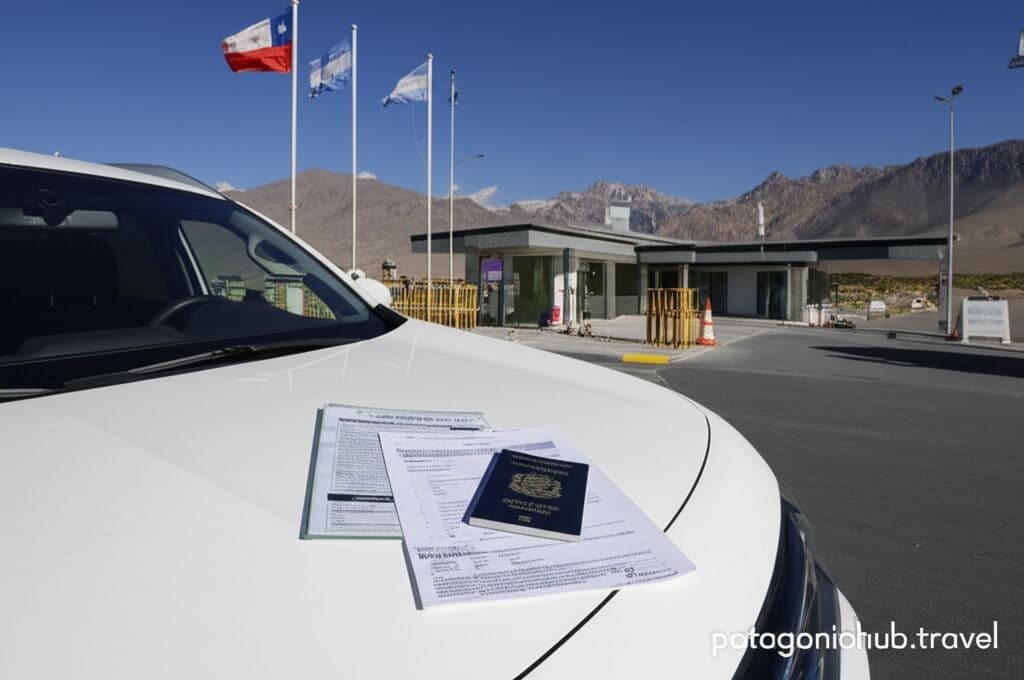
Create a professional photograph showing a modern rental car (SUV) with official border crossing documents displayed on the hood, including a notarized paper (Poder Notarial), vehicle registration, and passport. The scene is set at a Chile-Argentina border checkpoint with the customs building and flags visible in the background. Mountains and clear blue sky frame the composition. Style: Professional travel photography with natural lighting, 16:9 aspect ratio. No people in focus. Include subtle 'patagoniahub.travel' branding in the bottom right corner.
Related Guides
Chile-Argentina Border Crossing by Car: Complete Guide for Self-Drivers
Everything you need to know about crossing the Chile-Argentina border by car in Patagonia. From permits and documentation to wait times, food restrictions, and step-by-step procedures - your complete 2026 guide.
Cancha Carrera Border Crossing: Complete Step-by-Step Guide 2026
Detailed walkthrough of the Cancha Carrera / Río Turbio border crossing between Puerto Natales and El Calafate. Step-by-step procedures, documents, timings, and tips to cross smoothly.

Chile Food Restrictions at Border: What You Can't Bring (2026 Guide)
Complete guide to Chile's strict food import restrictions at border crossings. Learn what's prohibited (fruits, meat, dairy, seeds), allowed items, SAG inspection process, penalties ($200+ fines), and how to avoid confiscation when crossing from Argentina.